
No Legal Shield Without Compliance: Meta Faces Pressure to Remove Child Abuse Material in India
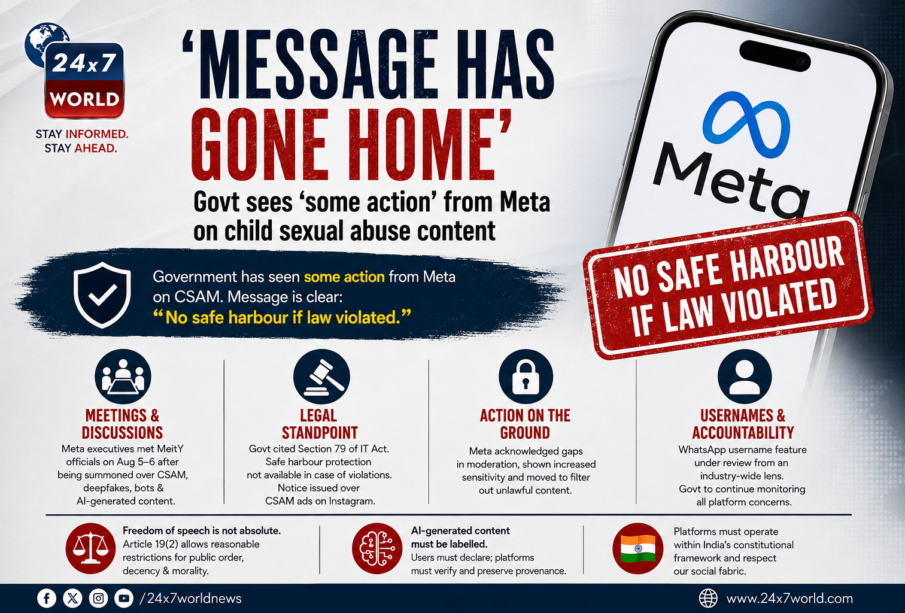
Meta is facing increased regulatory pressure in India to strengthen its efforts against child sexual abuse material (CSAM), deepfakes, bot accounts, and other forms of harmful online content. The Indian government has emphasized that social media platforms must comply with Indian laws and fulfill their legal due-diligence obligations to retain protection from liability for user-generated content.
Officials from the Ministry of Electronics and Information Technology (MeitY) said that the government’s objective is to reduce online harm and protect users rather than impose unnecessary censorship.
The development follows meetings between senior Meta executives, including Chief Global Affairs Officer Joel Kaplan, Union Minister Ashwini Vaishnaw, and senior MeitY officials in early August. The discussions focused on how major digital platforms are addressing illegal and harmful content, including CSAM, AI-generated material, deepfakes, and automated accounts.
Meta Acknowledges Challenges With Content Moderation
During discussions with government officials, Meta acknowledged challenges with its automated content moderation systems. The company explained that the enormous volume of content uploaded across its platforms makes it difficult for automated systems to identify and respond to every instance of unlawful material accurately.
Meta also referred to an incident in which an automated moderation error temporarily restricted a Facebook post involving Prime Minister Narendra Modi. The incident highlighted the challenges platforms face when relying heavily on automated systems to moderate content at scale.
However, the government has made it clear that technological difficulties do not remove platforms’ responsibility to comply with Indian law.
Section 79 Protection Depends on Due Diligence
One of the key issues discussed was Section 79 of the Information Technology Act, 2000.
Section 79 provides certain legal protections to online intermediaries for third-party content when they meet the applicable requirements and due-diligence obligations. The government reminded Meta that failure to follow these requirements can put this legal protection at risk.
This means social media companies operating in India cannot simply rely on their status as technology platforms. They are expected to take appropriate steps to address unlawful content and comply with India’s intermediary regulations.
Government Raises Concern Over CSAM in Paid Instagram Ads
Another major concern raised by the government involved child sexual abuse material appearing in paid advertisements on Instagram.
MeitY issued a notice to Meta regarding the issue, highlighting the need for stronger safeguards around advertising systems. The appearance of illegal material in paid promotions raises concerns not only about content moderation but also about the screening and verification processes used before advertisements are distributed to users.
The issue places additional pressure on platforms to strengthen automated detection as well as human review mechanisms.
WhatsApp Username Feature Under Government Review
The government is also examining WhatsApp’s planned username feature, which would allow users to connect through usernames or handles rather than directly sharing their phone numbers.
MeitY is assessing the potential implications of handle-based communication and how such systems could affect online safety, identity verification, privacy, and law enforcement.
The review is also part of a broader examination of how similar username-based communication systems are being implemented across the social media industry.
AI-Generated Content Must Be Clearly Identified
The government has also reiterated its position on AI-generated and synthetic content.
Under India’s updated IT regulatory framework, platforms are expected to introduce mechanisms requiring users to declare synthetic or AI-generated content before publishing it. Platforms are also expected to maintain information about the origin of such content and take action against unlawful material.
The growing use of generative AI has made this issue increasingly important because manipulated images, videos, audio, and other synthetic media can be used to spread misinformation, impersonation, deepfakes, and other harmful material.
Clear labelling can help users distinguish between authentic content and material generated or manipulated using artificial intelligence.
Why Meta’s Compliance Matters
Meta operates some of the world’s largest social media platforms, including Facebook, Instagram, and WhatsApp. The scale of these services means that even a small percentage of harmful content can affect a large number of users.
For the Indian government, the issue is therefore not limited to individual posts. It involves the broader responsibility of technology companies to establish effective systems for detecting, reporting, restricting, and removing illegal content.
The government has stressed that foreign technology companies operating in India must follow the country’s legal framework and respect the constitutional and regulatory boundaries applicable within the country.
India Takes a Stronger Approach to Platform Regulation
The latest discussions reflect India’s broader effort to increase accountability among large technology and social media companies.
Governments around the world are facing similar challenges as platforms deal with increasingly sophisticated AI-generated content, online abuse, misinformation, fake accounts, and illegal material.
India’s position is that technology platforms should balance innovation and freedom of expression with user safety and legal compliance.
For companies such as Meta, this means investing in stronger moderation systems, improving safeguards for vulnerable users, responding quickly to illegal content, and maintaining compliance with India’s intermediary rules.
What Happens Next?
The government’s engagement with Meta indicates that online platform regulation in India is likely to remain an important policy issue.
The focus is expected to remain on:
- Removing child sexual abuse material and other illegal content.
- Improving content moderation and detection systems.
- Strengthening safeguards around paid advertisements.
- Increasing transparency around AI-generated and synthetic content.
- Assessing the impact of WhatsApp usernames and handle-based communication.
- Ensuring social media companies meet their legal due-diligence obligations.
The central message from the government is clear: legal protection for online platforms comes with legal responsibilities. As social media and artificial intelligence continue to evolve, companies operating in India will increasingly be expected to demonstrate that their systems can protect users while



Leave a reply









At 24x7World.com, we’re passionate about keeping you informed and engaged with the latest news from around the globe, 24/7. We’re not just another news website; we’re your go-to source for timely, accurate, and relevant updates on everything that matters.


