
India-Pakistan Relations: History, Border Tensions, Military Strength, and the Possibility of Future Conflict
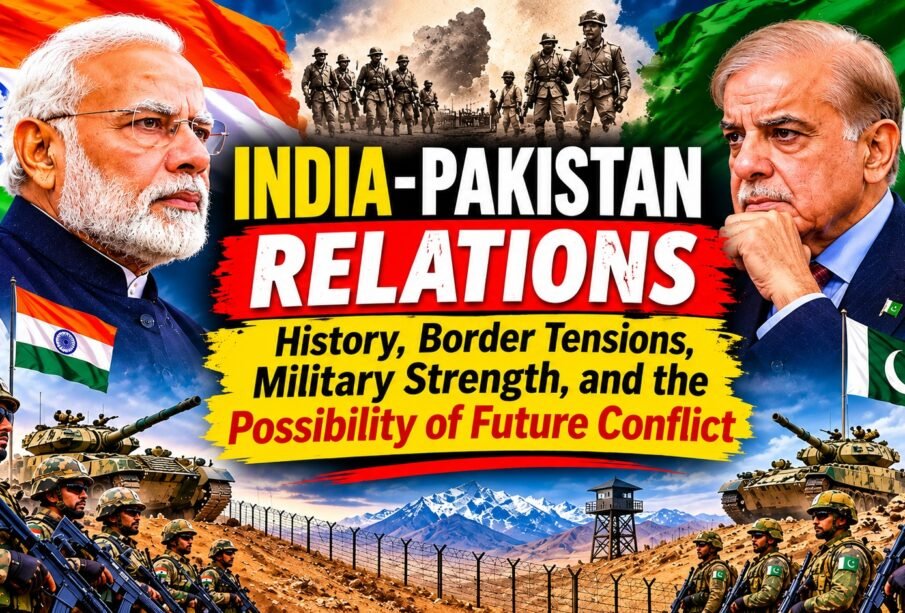
India and Pakistan share a long and complicated history shaped by political disagreements, territorial disputes, military conflicts, and diplomatic challenges.
Since the partition of British India in 1947, relations between the two neighbouring countries have experienced several periods of tension. Kashmir has remained one of the most significant issues affecting bilateral relations.
Both countries have developed powerful military forces and possess nuclear weapons, making regional stability particularly important.
Over the decades, several wars, border confrontations, and diplomatic efforts have influenced the relationship between India and Pakistan.
But why have relations between these countries remained tense? What were the major wars? How powerful are their military forces? And what could the future hold?
Let’s explore the history and major developments in India-Pakistan relations.
1. How Did India and Pakistan Become Separate Countries?
India and Pakistan became independent countries in August 1947 following the end of British colonial rule.
The partition divided British India into two independent nations based largely on religious demographics and political arrangements.
The division resulted in one of the largest mass migrations in modern history. Millions of people crossed the newly established borders, while widespread violence and communal unrest affected different regions.
The partition also created disagreements over the princely states, particularly Jammu and Kashmir.
The ruler of Jammu and Kashmir signed the Instrument of Accession to India in October 1947, following an invasion by tribal forces from Pakistan. This development led to the first India-Pakistan war.
2. India-Pakistan War of 1947-48
The first major military conflict between India and Pakistan began shortly after independence.
The conflict centred on Jammu and Kashmir.
Indian forces entered the region following the accession of Jammu and Kashmir to India. Fighting continued between Indian and Pakistani forces until a United Nations-mediated ceasefire came into effect on January 1, 1949.
The ceasefire established a line separating the territories controlled by both countries, which later became known as the Line of Control (LoC).
The Kashmir dispute remained unresolved and became a major source of future tensions.
3. India-Pakistan War of 1965
The 1965 war was another major military confrontation between the two neighbouring countries.
Tensions increased over Kashmir, and military operations expanded across the international border.
Both countries deployed ground forces, tanks, artillery, and aircraft during the conflict.
The fighting ended following a ceasefire, and the two countries signed the Tashkent Declaration in January 1966 with the involvement of the Soviet Union.
The agreement aimed to restore peace and return forces to their pre-war positions.
4. The 1971 India-Pakistan War
The 1971 war was one of the most significant events in South Asian history.
Political tensions in East Pakistan, widespread violence, and a major refugee crisis contributed to the conflict.
Millions of refugees entered India, creating a serious humanitarian and political challenge.
India intervened militarily in December 1971 after war broke out between the two countries.
The conflict ended on December 16, 1971, when Pakistani forces in East Pakistan surrendered.
Bangladesh subsequently emerged as an independent country.
The war significantly changed the political and geographical situation in South Asia.
5. Kargil War of 1999
The Kargil War took place in the mountainous region of Kargil in Jammu and Kashmir in 1999.
Indian forces discovered that Pakistani soldiers and armed personnel had occupied strategic positions on the Indian side of the Line of Control.
India launched military operations to regain control of the occupied positions.
The conflict involved difficult high-altitude military operations, artillery exchanges, and air support.
Indian forces eventually regained control of the positions.
The Kargil conflict demonstrated the challenges of maintaining security in mountainous border regions.
6. India vs Pakistan Military Strength
India and Pakistan have developed substantial military capabilities since independence.
Both countries maintain armies, air forces, naval forces, missile systems, and nuclear arsenals.
However, their overall military resources differ considerably.
| Military Category | India | Pakistan |
|---|---|---|
| Army | Larger force | Smaller force |
| Air Force | Large and diverse fleet | Modern combat aircraft |
| Navy | Larger naval capabilities | Smaller naval fleet |
| Nuclear weapons | Yes | Yes |
| Defence industry | Expanding domestic manufacturing | Developing domestic capabilities |
| Strategic focus | Regional and global security | Primarily regional security |
India has a larger economy and higher overall defence spending. Pakistan maintains significant military capabilities, particularly in relation to its regional security requirements.
Military strength alone does not determine the outcome of a conflict. Geography, intelligence, technology, logistics, and political decisions are also important.
7. Why Is Kashmir Important in India-Pakistan Relations?
Kashmir remains one of the most sensitive issues between India and Pakistan.
Both countries have competing territorial claims over the region, while India administers Jammu and Kashmir and Pakistan administers areas including Pakistan-occupied Kashmir.
The region has considerable strategic importance because of its geography, water resources, and proximity to important international borders.
The dispute has influenced military deployments, political discussions, diplomatic relations, and security policies for decades.
Resolving the issue remains a major challenge for regional peace.
8. Can India and Pakistan Fight Another War?
The possibility of another military confrontation cannot be completely ruled out.
Several factors can increase tensions:
- Cross-border terrorism and security incidents.
- Disagreements over Kashmir.
- Military confrontations along the Line of Control.
- Diplomatic and political disagreements.
- Regional strategic competition.
However, both countries understand the serious consequences of a large-scale conflict.
Their nuclear capabilities make military escalation particularly dangerous.
International diplomatic involvement, communication channels, and confidence-building measures can help prevent further escalation.
9. Economic Impact of an India-Pakistan Conflict
A military conflict would have consequences beyond national security.
Potential economic effects include:
- Disruption of regional trade.
- Increased defence expenditure.
- Pressure on financial markets.
- Reduced investor confidence.
- Disruptions to transportation and business activities.
- Humanitarian challenges in affected regions.
Peaceful relations could create opportunities for trade, tourism, investment, and regional economic cooperation.
10. What Is the Future of India-Pakistan Relations?
The future of India-Pakistan relations will depend on political decisions, security developments, and diplomatic efforts.
Both countries have important economic and social priorities that require stability.
Improved communication, counterterrorism cooperation, peaceful border management, and diplomatic engagement could help reduce tensions.
Although disagreements remain significant, dialogue and peaceful negotiations offer a better alternative to military confrontation.
Conclusion
India-Pakistan relations have been shaped by decades of historical disagreements, military conflicts, and political challenges.
From the partition of 1947 to the wars of 1965 and 1971 and the Kargil conflict of 1999, both countries have experienced major turning points.
Kashmir, cross-border security concerns, and political differences continue to influence bilateral relations.
Both nations possess significant military capabilities, including nuclear weapons. Therefore, maintaining peace and preventing military escalation remain important for South Asian stability.
The future of the region will depend on whether both countries can manage their differences through diplomacy, communication, and peaceful cooperation.
Frequently Asked Questions
1. When did India and Pakistan become separate countries?
India and Pakistan became independent countries in August 1947 following the partition of British India.
2. How many wars have India and Pakistan fought?
The countries fought major wars in 1947-48, 1965, 1971, and 1999. The 1999 Kargil conflict is sometimes classified separately from a full-scale war.
3. Why do India and Pakistan have disputes over Kashmir?
The dispute began during partition in 1947 and involves competing territorial claims and the political status of Jammu and Kashmir.
4. Who has a stronger military, India or Pakistan?
India has greater overall military resources, a larger economy, and higher defence spending. Pakistan also maintains significant military capabilities.
5. Do India and Pakistan have nuclear weapons?
Yes. Both countries possess nuclear weapons and delivery systems.
6. Could India and Pakistan fight another war?
Another conflict is possible, but it is not inevitable. Diplomacy, security cooperation, and effective communication are important for preventing escalation.
7. What happened during the 1971 India-Pakistan War?
The 1971 war resulted in the surrender of Pakistani forces in East Pakistan and the emergence of Bangladesh as an independent country.

Leave a reply








At 24x7World.com, we’re passionate about keeping you informed and engaged with the latest news from around the globe, 24/7. We’re not just another news website; we’re your go-to source for timely, accurate, and relevant updates on everything that matters.


