
Patel Nagar’s Raj Kumar Anand’s Political Switch: Corruption Allegations, ED Probe and Anti-Defection Action
Patel Nagar’s Raj Kumar Anand’s Political Switch: Corruption Allegations, ED Probe and Anti-Defection Action
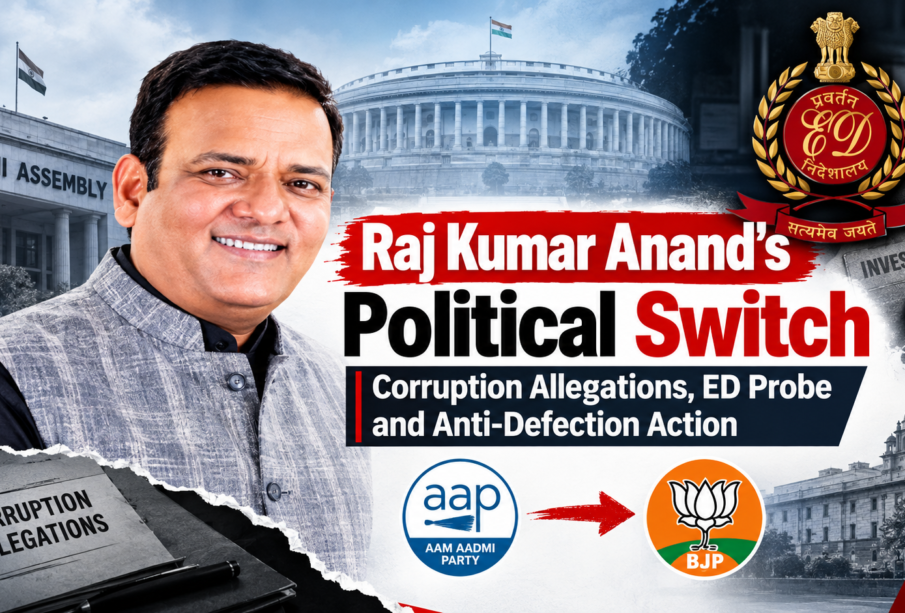
New Delhi: Former Delhi minister Raj Kumar Anand’s exit from the Aam Aadmi Party (AAP) in 2024 came amid a series of political and legal controversies, including an Enforcement Directorate investigation into alleged customs-duty evasion and hawala payments, his subsequent switch to the Bahujan Samaj Party (BSP), and his eventual disqualification from the Delhi Assembly under the anti-defection law.
Raj Kumar Anand, who represented Patel Nagar and served as Delhi’s Social Welfare Minister, resigned from both the Delhi Cabinet and the AAP on April 10, 2024, accusing the party of being “mired in the quicksand of graft” and alleging that it had failed to adequately represent the Dalit community.
His allegations against his former party came while Anand himself was already facing scrutiny from the Enforcement Directorate.
ED probe over alleged hawala payments and customs evasion
In November 2023, the ED conducted searches at 13 locations in Delhi-NCR, Kolkata and Uttar Pradesh as part of a money-laundering investigation involving Anand and other connected persons and entities.
According to the ED, its investigation was based on a prosecution complaint filed by the Directorate of Revenue Intelligence (DRI) under the Customs Act. The agency said the complaint alleged that Anand had made hawala payments to China and evaded customs duty of approximately ₹7 crore on various imports. The ED also said its searches recovered ₹74 lakh in cash along with documents and digital records relating to alleged unaccounted business investments and hawala payments.
These were allegations, not a finding of guilt.
Patel Nagar’s Raj Kumar Anand rejected the allegations and said the customs matter related to an old case dating back to 2005. He maintained that the ED action was being used to cause him distress and denied wrongdoing.
A resignation framed around corruption
Against this backdrop, Anand’s April 2024 resignation generated additional political attention.
While announcing his departure from AAP, Anand accused the party of abandoning the anti-corruption principles on which it was founded. He said he did not want his name associated with what he described as “corrupt actions” and questioned the party’s moral authority to remain in government.
AAP, however, rejected Anand’s allegations. Party leaders suggested that central investigative agencies were being used against AAP leaders and questioned the circumstances surrounding Anand’s departure, particularly given the ED scrutiny he had already faced.
Anand denied that he was leaving because of pressure from the investigating agencies.
AAP to BSP — and then Assembly disqualification
Following his resignation, Anand joined the BSP and contested the 2024 Lok Sabha election from New Delhi on a BSP ticket.
However, his decision to leave AAP while retaining his Assembly seat led to proceedings under India’s anti-defection framework.
On June 14, 2024, Delhi Assembly Speaker Ram Niwas Goel announced Anand’s disqualification from the Assembly. The Speaker said Anand had been given three opportunities to appear and submit his position but did not attend the hearings.
The action was taken under the Tenth Schedule of the Constitution, commonly known as the anti-defection law. The provision includes disqualification where an elected member voluntarily gives up membership of the political party on whose ticket the member was elected, subject to constitutional exceptions.
Anand disputed the action and described it as reflecting what he called an “anti-Dalit mentality” within AAP. He said he would consider legal remedies against the disqualification.
From BSP to BJP
The political episode took another turn soon afterwards.
Anand subsequently joined the Bharatiya Janata Party, after having moved from AAP to BSP within the same year.
The sequence — AAP resignation, BSP candidature, Assembly disqualification and subsequent BJP entry — became a major feature of Anand’s political trajectory in 2024.
The political circumstances surrounding his departure also generated competing claims. While AAP leaders questioned whether investigative pressure played a role, Anand rejected that explanation and maintained that his decision to leave AAP was based on his political disagreements with the party.
Other criminal proceedings
Publically available data shows pending criminal proceedings.
He has a case arising from a 2009 FIR at Kirti Nagar, involving charges under Sections 323, 325, 427 and 34 of the IPC. The allegations relate to causing hurt, grievous hurt, mischief causing damage and acts allegedly committed by several persons in furtherance of a common intention.
He also faced customs-related complaint under Sections 132 and 135 of the Customs Act.
These disclosures concern pending proceedings and allegations; they should not be described as convictions.
A political career marked by competing corruption claims
Anand’s political journey has consequently produced an unusual contrast.
He left AAP while accusing the party of corruption, at a time when he was himself facing an ED investigation arising from allegations of customs-duty evasion and hawala payments. Anand denied those allegations, while the AAP disputed his explanation for leaving the party.
His subsequent movement from AAP to BSP and then BJP, coupled with his disqualification from the Delhi Assembly under the anti-defection law, added another layer to the controversy.
Know More : https://24x7world.com/




Leave a reply









At 24x7World.com, we’re passionate about keeping you informed and engaged with the latest news from around the globe, 24/7. We’re not just another news website; we’re your go-to source for timely, accurate, and relevant updates on everything that matters.


