
BRICS 2026 in India: What the “One Bus” Move Really Says About the Summit
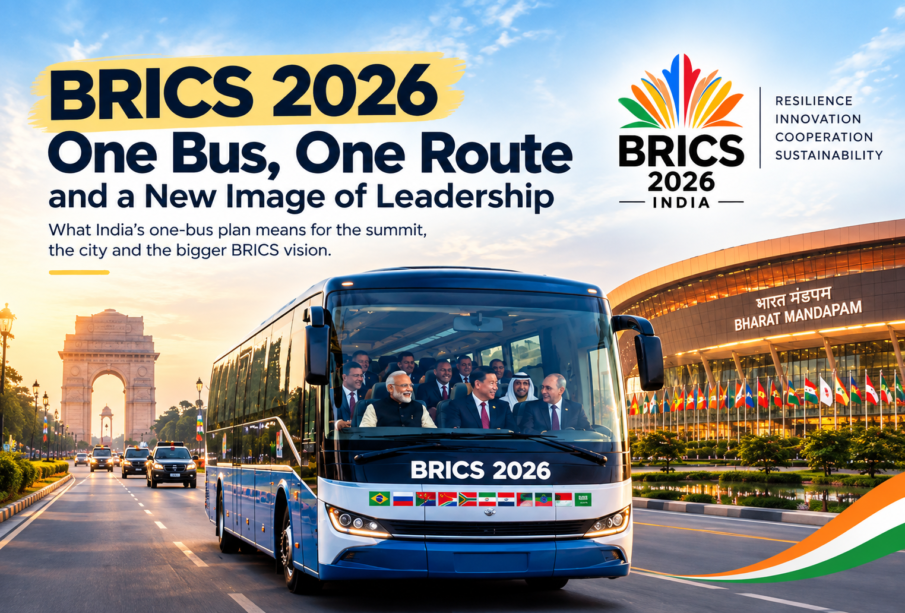
A Bus Ride Has Become One of the Talking Points Around BRICS 2026
International summits are usually associated with grand venues, official cars and layers of security.
So when Indian ministers and chief ministers attending BRICS 2026 are asked to travel together by bus, it naturally gets people talking.
The journey is expected to take leaders from Parliament to Bharat Mandapam in New Delhi, where the BRICS leaders’ summit is being held.
On the surface, it is simply a traffic and security decision.
But look a little closer and there is an interesting story behind it.
A Practical Decision for a Busy City
Delhi doesn’t exactly need another reason for traffic to slow down.
When several VIP convoys move through the city separately, authorities have to manage individual security movements, traffic diversions and road restrictions.
A shared bus can simplify that process.
Instead of organising multiple movements, security agencies can coordinate one larger movement.
For commuters, the hope is straightforward: less disruption on the roads.
That’s particularly relevant during BRICS 2026 because the summit is bringing heightened security arrangements to the capital.
BRICS Has Changed Since Its Early Days
The organisation hosting the summit today looks very different from the original BRIC grouping.
The name initially represented Brazil, Russia, India and China. South Africa later joined, turning BRIC into BRICS.
The group has since expanded further and now has 11 members.
That expansion has made BRICS more representative of emerging economies, but it has also made cooperation more complicated.
The members don’t share identical economic interests or foreign-policy priorities.
Getting everyone to agree isn’t always easy.
And that makes the theme of cooperation particularly relevant.
India’s BRICS Presidency Has a Broad Focus
India is chairing BRICS in 2026 with a focus on Resilience, Innovation, Cooperation and Sustainability.
The agenda stretches well beyond traditional diplomacy.
Economic cooperation, technology, climate and sustainability, health, trade and financial systems are all part of the wider BRICS programme.
India has also been emphasising the role of young people, entrepreneurs and innovation in the organisation’s future.
The idea is to make BRICS more than a forum where government leaders meet once a year.
It is about building relationships that can continue working between summits.
Why Technology Could Be a Big Part of the Conversation
One of the more interesting areas for BRICS is digital finance.
As international trade becomes increasingly digital, countries are looking for faster and more affordable ways to move money across borders.
India has been advocating greater cooperation around digital payment systems and exploring ways BRICS economies could improve cross-border transactions.
If successful, this could eventually matter to businesses far beyond government meetings.
A small company exporting products, for example, doesn’t care much about diplomatic language.
It cares about whether an international payment arrives quickly, safely and at a reasonable cost.
That’s where BRICS cooperation can become practical.
The Summit Is Also About India’s Position in the World
There is another reason BRICS 2026 matters to India.
Hosting a major international grouping gives the country an opportunity to shape the conversation rather than simply participate in it.
India can push its priorities, build relationships with other emerging economies and present itself as a bridge between different parts of the global economy.
The challenge is turning that diplomatic opportunity into measurable outcomes.
A successful summit isn’t judged by how impressive the venue looks.
It is judged by what happens after the leaders return home.
What Will People Remember About BRICS 2026?
There will probably be plenty of official photographs from Bharat Mandapam.
There will be speeches, meetings and statements.
There will be discussions about trade, technology, finance and global governance.
But sometimes, one simple image can capture the mood of an event better than a long speech.
A group of Indian leaders travelling together in a single bus is one of those images.
It represents efficiency on a very practical level.
At the same time, it creates an unusual picture of political leaders sharing the same journey.
And that makes it memorable.
The Bigger BRICS Question
Ultimately, the biggest question isn’t whether the bus arrangement works.
It’s whether the expanded BRICS group can turn its growing influence into meaningful cooperation.
With 11 countries at the table, there are enormous opportunities — but also plenty of differences to navigate.
India’s role as host is therefore about finding common ground.
That could mean cooperation in trade.
It could mean better financial connectivity.
It could mean collaboration in technology and sustainability.
Or it could simply mean keeping dialogue open between countries that don’t always see the world in the same way.
Final Word
The BRICS 2026 Summit in New Delhi is attracting attention for all the obvious reasons — powerful countries, major economic questions and India’s role as host.
But the one-bus arrangement adds a more human and practical element to the story.
It reminds us that behind the diplomatic headlines, someone still has to deal with traffic, security, logistics and the realities of running a massive international event.
And perhaps that’s the best way to look at it.




Leave a reply








At 24x7World.com, we’re passionate about keeping you informed and engaged with the latest news from around the globe, 24/7. We’re not just another news website; we’re your go-to source for timely, accurate, and relevant updates on everything that matters.

