
How Artificial Intelligence Is Changing Daily Life
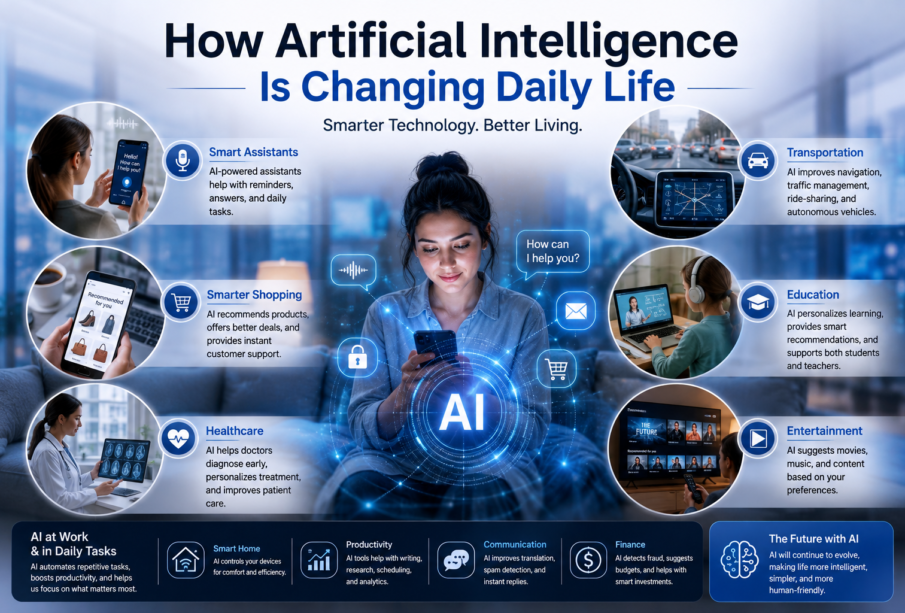
Artificial Intelligence
Introduction
Artificial intelligence is no longer something that exists only in science fiction movies or advanced research laboratories. Today, AI is becoming part of everyday life for millions of people.
From the moment people unlock their smartphones to the videos they watch, products they buy and routes they follow, AI-powered systems often work in the background. These technologies can analyze information, recognize patterns, make predictions and provide personalized experiences.
In 2026, the role of AI in daily life is continuing to grow. Businesses, schools, healthcare organizations and technology companies are increasingly using artificial intelligence to improve services and automate tasks.
This article explores how artificial intelligence is changing daily life, the major areas where AI is being used and what the future could look like.
What Is Artificial Intelligence?
Artificial intelligence, commonly known as AI, refers to computer systems designed to perform tasks that normally require aspects of human intelligence.
Depending on the system, AI can be used to:
- Analyze large amounts of data
- Recognize images and speech
- Understand and generate language
- Identify patterns
- Make predictions
- Automate repetitive tasks
- Provide recommendations
AI systems do not all work in the same way. Some are designed for specific tasks, while more advanced generative AI tools can create text, images, audio, software code and other types of content.
As these technologies become easier to access, AI is becoming more visible in everyday activities.
1. AI Is Changing How We Use Smartphones
Smartphones are among the most common examples of AI in daily life.
Many mobile devices use AI to improve cameras, recognize speech, organize photos and provide personalized suggestions. Voice assistants can process spoken commands, while predictive text can suggest words and correct typing mistakes.
AI can also help smartphones:
- Improve photos automatically
- Detect faces and objects
- Filter spam messages
- Translate languages
- Suggest replies
- Improve battery management
- Organize information
As mobile technology develops, AI is expected to become even more integrated into the way people use their phones.
2. AI Is Transforming Online Search
Searching for information online is also changing because of artificial intelligence.
Traditional search engines mainly provided a list of websites related to a user’s query. AI-powered search can also help summarize information, answer complex questions and provide more conversational results.
This could change how people research topics online.
For example, users may increasingly ask detailed questions rather than searching only for short keywords. AI systems can then help organize information into easier-to-understand answers.
However, this also makes it important for users to check information carefully. AI-generated answers can sometimes contain mistakes or lack important context.
3. AI Is Personalizing Entertainment
Artificial intelligence is already widely used by entertainment platforms.
When a streaming platform recommends a movie or a music service suggests a song, algorithms may analyze user behavior to provide personalized recommendations.
AI can help platforms understand patterns such as:
- What people watch
- How long they watch
- Which content they skip
- What they search for
- Which types of content they enjoy
This allows companies to create more personalized experiences.
AI is also being used in content creation. New tools can help creators edit videos, generate images, create music and automate certain production tasks.
4. AI Is Changing Online Shopping
E-commerce companies use AI to improve the shopping experience.
When an online store recommends products based on previous searches or purchases, artificial intelligence may play a role in analyzing customer behavior.
AI can be used for:
- Product recommendations
- Personalized offers
- Customer support chatbots
- Inventory forecasting
- Fraud detection
- Search improvement
- Price analysis
For consumers, this can make shopping faster and more personalized. For businesses, AI can help improve customer service and understand demand.
At the same time, companies must handle customer data responsibly and protect privacy.
5. AI Is Improving Customer Service
Many businesses now use AI-powered chatbots and virtual assistants.
These systems can answer common questions, provide information and guide customers through basic processes. This can help businesses provide support outside traditional working hours.
For example, AI customer service tools may assist with:
- Order tracking
- Frequently asked questions
- Appointment booking
- Basic troubleshooting
- Account information
- Product recommendations
Human support remains important, particularly when customers have complex problems. However, AI can help automate routine interactions and reduce waiting times.
6. AI Is Changing Education
Education is another area where AI is creating new possibilities.
Students can use AI tools for explanations, practice questions, research assistance and personalized learning. Teachers can also use technology to help prepare materials and organize certain tasks.
AI may help create learning experiences based on a student’s needs and progress.
Possible uses include:
- Personalized study plans
- Language learning
- Automated practice questions
- Writing assistance
- Research support
- Accessibility tools
- Instant explanations
However, students need to use AI responsibly. AI should support learning rather than replace critical thinking, independent research and understanding.
Schools and universities are also developing policies around the appropriate use of AI.
7. AI Is Changing the Workplace
The workplace is one of the areas where artificial intelligence is having a significant impact.
AI tools can automate repetitive tasks and help employees analyze information, write drafts, summarize documents and manage data.
Different industries are finding different uses for AI.
For example:
- Marketers can analyze campaign data.
- Developers can receive coding assistance.
- Customer service teams can automate routine queries.
- Researchers can organize large amounts of information.
- Businesses can use AI for forecasting.
Rather than affecting every job in the same way, AI is changing specific tasks within many jobs.
This means employees may need to develop new skills, including the ability to work effectively with AI-powered tools.
8. AI Is Supporting Healthcare
Artificial intelligence is also being used to support healthcare professionals and researchers.
AI systems can analyze large amounts of medical data and may help identify patterns that require further attention. Technology can also assist with administrative work and research.
Potential applications include:
- Medical image analysis
- Research support
- Drug discovery
- Administrative automation
- Patient scheduling
- Health monitoring
AI should not be viewed as a replacement for qualified healthcare professionals. Medical decisions require appropriate expertise, testing and human oversight.
However, AI could become an increasingly valuable tool for supporting healthcare systems.
9. AI Is Helping People Travel
AI is changing the way people plan and experience travel.
Navigation applications use data to help identify routes and estimate travel times. Travel platforms can recommend destinations, flights and hotels based on search behavior and preferences.
AI can assist travelers with:
- Route planning
- Language translation
- Travel recommendations
- Customer support
- Price monitoring
- Personalized itineraries
Real-time data and intelligent systems could make travel planning increasingly convenient.
10. AI Is Improving Home Technology
Smart home technology is another example of AI in everyday life.
Some devices can learn from user behavior and automate certain activities. Voice-controlled systems allow people to control compatible devices using spoken commands.
AI-powered home technology may help with:
- Energy management
- Home security
- Smart lighting
- Voice control
- Device automation
- Personalized settings
As more connected devices enter homes, security and privacy will become increasingly important considerations.
The Benefits of AI in Daily Life
Artificial intelligence can offer several potential benefits.
Saving Time
AI can automate repetitive tasks and help people complete certain activities more quickly.
Personalization
Technology can provide recommendations and services based on individual preferences.
Better Access to Information
AI-powered tools can help users find, organize and understand information.
Improved Accessibility
Speech recognition, translation and other AI technologies can make digital services more accessible.
Business Efficiency
Companies can use AI to automate tasks, analyze information and improve operations.
Challenges of Artificial Intelligence
Despite its benefits, AI also creates important challenges.
Privacy Concerns
AI systems often depend on data. Users and organizations need to understand how information is collected and used.
Misinformation
AI can create realistic text, images, videos and audio. This increases the importance of verifying information before sharing it.
Job Changes
Automation may change certain tasks and create demand for new skills.
Bias and Fairness
AI systems can produce unfair or inaccurate results if they are poorly designed or trained using biased information.
Overdependence on Technology
People should continue to use critical thinking rather than accepting every AI-generated result as automatically correct.
What Will the Future of AI Look Like?
The future of artificial intelligence will likely involve greater integration into everyday technology.
AI may become more capable of understanding context, working across different types of information and completing multi-step tasks.
Some future developments could include:
- More advanced AI assistants
- Improved robotics
- Smarter healthcare technology
- Better language translation
- AI-powered education tools
- More personalized digital services
- Advanced automation
At the same time, governments, businesses and technology companies will continue discussing how AI should be developed and used responsibly.
Frequently Asked Questions
How is artificial intelligence used in everyday life?
Artificial intelligence is used in smartphones, search engines, social media, online shopping, entertainment platforms, navigation, customer service and many other everyday technologies.
What are some examples of AI in daily life?
Examples include voice assistants, product recommendations, predictive text, spam filters, navigation apps, facial recognition, customer service chatbots and personalized entertainment suggestions.
How does AI make life easier?
AI can automate repetitive tasks, provide recommendations, organize information, improve accessibility and help people complete certain activities more efficiently.
Is AI safe to use?
AI can be useful, but users should protect their personal information and verify important AI-generated information. The safety of an AI system depends on how it is designed, tested and used.
Will AI replace human jobs?
AI is likely to automate or change certain tasks, but its impact will vary across industries and occupations. New roles and skills may also emerge as AI technology develops.
Conclusion
Artificial intelligence is becoming an increasingly important part of modern life.
From smartphones and online shopping to education, work, entertainment and healthcare, AI-powered technology is changing how people interact with the digital world.
The impact of AI will continue to grow in the coming years. While the technology offers opportunities to improve efficiency, accessibility and innovation, it also raises important questions about privacy, misinformation, fairness and the future of work.
The key will be learning how to use AI responsibly. As artificial intelligence becomes more powerful and accessible, people who understand both its benefits and limitations will be better prepared for a rapidly changing digital future.




Leave a reply








At 24x7World.com, we’re passionate about keeping you informed and engaged with the latest news from around the globe, 24/7. We’re not just another news website; we’re your go-to source for timely, accurate, and relevant updates on everything that matters.


