
K.D. Medical College Mathura Faces Scrutiny over Patient Care, Student Death and Other Controversies
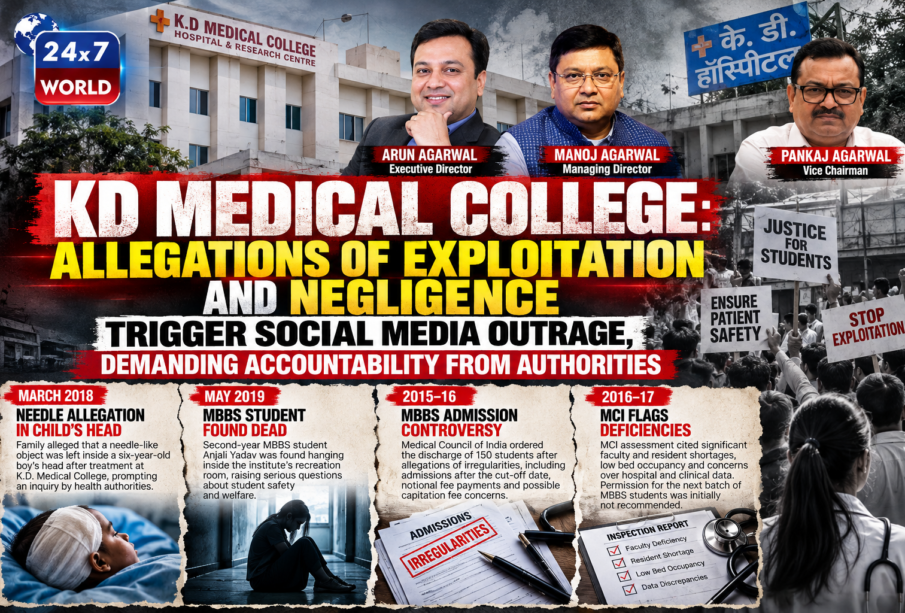
K.D. Medical College, Hospital & Research Centre in Mathura has, over the years, faced a series of allegations and reported incidents involving patient care, student welfare and institutional accountability. While the institution continues to operate as a medical education and healthcare centre, several incidents reported by the media have raised questions about the safeguards in place for patients and students.
The institution’s senior leadership includes Manoj Agarwal, Managing Director, and Pankaj Agarwal, Vice Chairman, according to the college’s official website. Arun Agarwal has also been associated with the R.K. Educational Group in a senior executive capacity.
The 2018 Needle Allegation: A Medical Negligence Controversy
One of the most widely reported controversies involving K.D. Medical College emerged in 2018 after the family of a six-year-old boy alleged that a needle-like object had been left inside his head following treatment at the hospital.
According to reports, the child, Bansi, had suffered a head injury after falling from stairs and was taken to K.D. Medical College, where he received stitches. His father later alleged that he discovered a sharp, needle-like object in the wound while changing the bandage.
The allegation led to intervention by the Mathura Chief Medical Officer, who ordered a detailed examination and constituted a medical panel to investigate the matter. A police complaint was also reported.
Importantly, the allegation was disputed by the hospital. Manoj Agarwal, then identified in media reports as the managing director/owner of the institution, denied negligence and argued that the child had subsequently received dressing elsewhere. The hospital’s position was that the investigation would establish what had actually happened.
Thus, the episode remains best described as a reported medical-negligence allegation followed by an official inquiry, rather than as a proven finding of negligence.
2019: Death of an MBBS Student Raises Questions About Student Welfare
Another serious incident occurred in May 2019, when Anjali Yadav, a second-year MBBS student, was found hanging inside the institute’s recreation room.
Police said that Anjali had reportedly been missing since the morning and that her roommate subsequently informed the hostel warden. Her body was later discovered inside the recreation room after the door was found locked from the inside.
According to police statements reported at the time, some of Anjali’s classmates said she had been worried about her examination performance and impending results. Police indicated that this could have been a possible factor, while also stating that further information would emerge through the investigation and post-mortem process.
The incident nevertheless generated questions from her family. Her uncle reportedly questioned why the family had not been informed earlier, alleging a delay of around 18 hours between her disappearance and the family being informed.
The case therefore became another point of discussion around student safety, hostel monitoring and institutional responsibility.
COVID-19 Second Wave: Case Over Alleged Patient-Care Lapses and Excess Charges
According to reports from the period, the allegations related to negligence in patient care and the alleged collection of unauthorised or excessive charges during the pandemic, when hospitals were dealing with a large number of critically ill COVID-19 patients.
The case was reportedly registered under Sections 269 and 270 of the Indian Penal Code (IPC), provisions concerning acts that could spread dangerous infectious diseases, along with Section 3 of the Epidemic Diseases Act. These provisions were invoked in the context of alleged violations during the COVID-19 crisis.
A Pattern of Concern or Separate Incidents?
It is important not to automatically connect separate incidents or assume that they share a common cause.
Reports from the same period also referred to deaths involving students of K.D. Dental College, an institution belonging to the same broader group. Those cases should be distinguished from incidents involving K.D. Medical College itself.
The 2019 Anjali case, for example, concerned a student of K.D. Medical College, while reports separately mentioned earlier deaths involving students of the group’s dental college.
This distinction matters when assessing claims about the institution’s record: different institutions within a larger educational group should not be treated as though they are the same college.
Leadership Under the Spotlight
The reported controversies have inevitably brought attention to the institution’s leadership and governance.
The college’s own website identifies Manoj Agarwal as Managing Director and Pankaj Agarwal as Vice Chairman.
Arun Agarwal has also appeared in recent institutional communications in a senior executive role within the R.K. Educational Group. A recent K.D. Medical College publication identifies him as the Chief Executive Officer of the R.K. Educational Group, while another institutional report identifies him as Executive Director of K.D. Medical College.
Consequently, discussions about institutional accountability have increasingly focused not only on individual incidents but also on management systems, patient-safety protocols, student welfare mechanisms and grievance redressal.
Why Transparency Matters
Medical colleges occupy a particularly sensitive position because they simultaneously function as educational institutions and healthcare providers.
Patients place their health and lives in the hands of doctors and hospital staff, while students depend on the institution for education, accommodation, examination support and a safe academic environment.
For that reason, allegations involving patient treatment or student welfare can have consequences extending beyond a single incident. Even when an allegation is ultimately not substantiated, transparent investigation and timely communication are important for maintaining public confidence.
The 2018 case demonstrates this point clearly: the allegation was denied by the hospital, but the authorities nevertheless ordered an inquiry.
Similarly, in the 2019 student death, police investigated the circumstances surrounding the incident and recorded statements concerning possible examination-related stress, while the family raised separate concerns about communication from the institution.
The Bigger Question: Accountability and Trust
The controversy surrounding K.D. Medical College is therefore not limited to one allegation or one incident. Rather, the reported cases raise broader questions about patient safety, student welfare, institutional transparency and accountability.
At the same time, allegations should not be confused with established findings. The 2018 medical-treatment controversy, for example, involved an official inquiry and competing accounts from the family and hospital. Likewise, the circumstances surrounding Anjali Yadav’s death were investigated by police, with examination performance reported as one possible factor rather than a definitive established cause.
For an institution entrusted with educating future doctors and treating patients, the most effective response to such concerns is transparency: clear investigations, documented findings, effective grievance mechanisms and demonstrable safeguards for both patients and students.
Ultimately, public trust in a medical institution depends not only on its infrastructure or academic achievements, but also on how it responds when something goes wrong—or when allegations of wrongdoing arise.




Leave a reply









At 24x7World.com, we’re passionate about keeping you informed and engaged with the latest news from around the globe, 24/7. We’re not just another news website; we’re your go-to source for timely, accurate, and relevant updates on everything that matters.


